Next.js RSC
Full Next.js React Server Components UI with .NET 10 Identity Auth Template back-end APIs
.NET 10 Next.js RSC Identity Auth Template
A modern full-stack .NET 10.0 + Next.js 16 project template that combines the power of ServiceStack with Next.js static site generation and React 19. It provides a production-ready foundation for building scalable web applications with integrated authentication, database management, and background job processing.
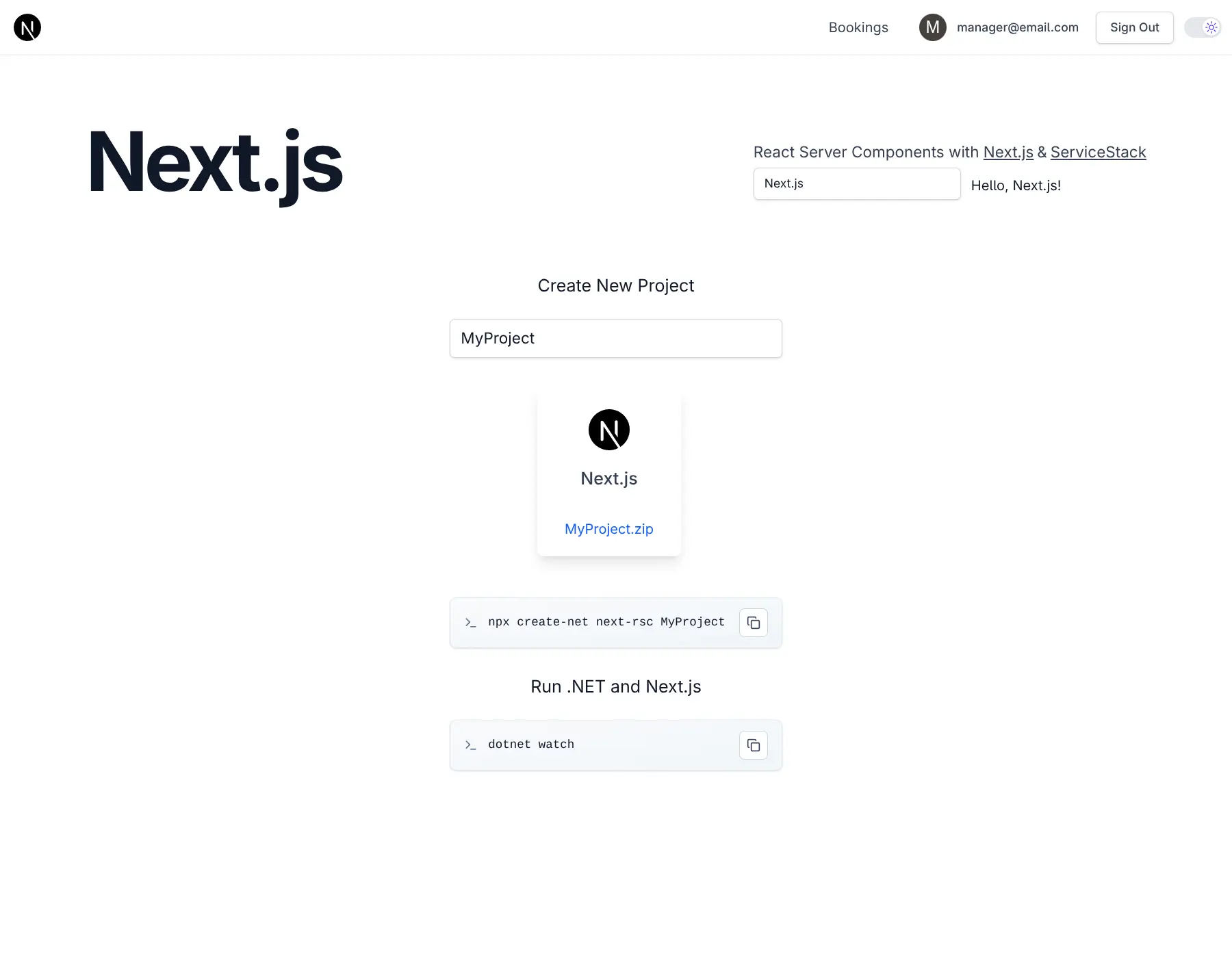
Quick Start
npx create-net next-rsc MyProjectGetting Started
Run Server .NET Project (automatically starts both .NET and Next.js dev servers):
cd MyProject
dotnet watch
Architecture
Unified Proxy Architecture
This template uses a consistent architecture across all environments where the .NET application always proxies requests to a full-featured Next.js server:
Development Mode:

- ASP.NET Core proxies requests to Next.js dev server (running on port 3000)
- Hot Module Replacement (HMR) support for instant UI updates
- WebSocket proxying for Next.js HMR functionality
- Automatic startup of Next.js dev server in
dotnet watch
Production Mode:

- Full Next.js capabilities including React Server Components and dynamic rendering
- Single container deployment with coordinated process management
- Both .NET and Node servers run side-by-side in the same unified Docker container
- ASP.NET Core proxies requests to Next.js production server (running on port 3000)
- Static file responses cached in
NodeProxyin-memory managed cache for optimal performance
Security
This template is immune to React Server Components vulnerabilities through a defense-in-depth approach:
- No Server Functions: The template doesn't use React Server Functions (
'use server'), eliminating the primary attack vector for Critical Vulnerabilities in React Server Components - Process Isolation: Node.js runs as an unprivileged user with no access to .NET config, credentials or secrets
- Environment Separation: Sensitive environment variables never reach the Node.js process
- File System Permissions: .NET application files are protected with root-only permissions
Even if a new vulnerability is discovered in React Server Components, the infrastructure limits the blast radius. An attacker with code execution in Node.js cannot access database credentials, API keys, or modify .NET code.
See Security Architecture Documentation for detailed analysis, implementation and automated testing details.
Core Technologies
Frontend (Next.js 16 + React 19)
- Next.js with static export capability
- Tailwind CSS 4.x - Utility-first styling with PostCSS
- TypeScript - Type-safe development
- Vitest - Modern testing framework
- ServiceStack React Components - Pre-built UI components
.NET Frontend (Integrated + Optional)
- Razor Pages - For Identity Auth UI (
/Identityroutes)
Backend (.NET 10.0)
- ServiceStack 10.x - High-performance web services framework
- ASP.NET Core Identity Auth - Complete authentication & authorization system
- Entity Framework Core - For Identity Auth data management
- OrmLite - ServiceStack's fast, lightweight Typed ORM
- SQLite - Default database (easily upgradable to PostgreSQL/SQL Server/MySQL)
Major Features
1. Authentication & Authorization
- ASP.NET Core Identity integration with role-based access control
- Custom user sessions with additional claims
- Admin users feature for user management at
/admin-ui/users - Email confirmation workflow (configurable SMTP)
- Razor Pages for Identity UI (
/Identityroutes) - Credentials-based authentication
2. AutoQuery CRUD
- Declarative API development with minimal code
- Complete Auth-protected CRUD operations (see Bookings example at
/bookings-auto) - Automatic audit trails (created/modified/deleted tracking)
- Built-in validation and authorization
- Type-safe TypeScript DTOs auto-generated from C# models
3. Background Jobs
BackgroundsJobFeaturefor async task processing- Command pattern for job execution
- Email sending via background jobs
- Recurring job scheduling support
- Upgradable to
DatabaseJobsFeaturefor enterprise RDBMS
4. Developer Experience
- Admin UI at
/admin-uifor App management - Health checks at
/upendpoint - Modular startup configuration pattern
- Code-first migrations with OrmLite
- Docker support with container publishing
- Kamal deployment configuration included
5. Production Features
- Static asset caching with intelligent cache invalidation
- Clean URLs without
.htmlextensions - HTTPS redirection and HSTS
- Data protection with persistent keys
- Health monitoring
- Database developer page for EF Core errors
Project Structure
MyApp/                         # .NET Backend (hosts both .NET and Next.js)
├── Configure.*.cs             # Modular startup configuration
├── Migrations/                # EF Core Identity migrations + OrmLite app migrations
├── Pages/                     # Identity Auth Razor Pages
└── wwwroot/                   # Production static files (from MyApp.Client/dist)

MyApp.Client/                  # React Frontend
├── app/                       # Next.js App Router pages
├── components/                # React components
├── lib/                       # Utilities and helpers
│   ├── dtos.ts                # Auto-generated from C# (via `npm run dtos`)
│   ├── gateway.ts             # ServiceStack JsonServiceClient
│   └── utils.ts               # Utility functions
├── public/                    # Static assets
├── dist/                      # Build output (production)
├── styles/                    # Tailwind CSS styles
└── next.config.mjs            # Next.js config for dev mode

MyApp.ServiceModel/            # DTOs & API contracts
├── *.cs                       # C# Request/Response DTOs
├── api.d.ts                   # TypeScript data models Schema
└── *.d.ts                     # TypeScript data models for okai code generation

MyApp.ServiceInterface/        # Service implementations
├── Data/                      # EF Core DbContext and Identity models
└── *Services.cs               # ServiceStack service implementations

MyApp.Tests/                   # .NET tests (NUnit)
├── IntegrationTest.cs         # API integration tests
└── MigrationTasks.cs          # Migration task runner

Dockerfile                     # Custom .NET + Next.js Dockerfile
entrypoint.sh                  # Coordinated .NET and Node process management
config/
└── deploy.yml                 # Kamal deployment settings
.github/
└── workflows/
    ├── build.yml              # CI build and test
    ├── build-container.yml    # Container image build
    └── release.yml            # Production deployment with Kamal
Development Workflow
For detailed information on the development workflow, including starting development servers, generating TypeScript DTOs, database migrations, and testing, see:
Development Workflow Documentation
Configuration
For detailed configuration information, including app settings, SMTP email setup, and upgrading to enterprise databases (PostgreSQL/SQL Server/MySQL), see:
Deployment
For deployment instructions, including Docker + Kamal setup and GitHub Actions configuration, see:
Ideal Use Cases
- SaaS applications requiring authentication
- Admin dashboards with CRUD operations
- Content-driven sites with dynamic APIs
- Applications needing background job processing
- Projects requiring both SSG benefits and API capabilities
- Teams wanting type-safety across full stack