Next.js RSC
Full Next.js React Server Components UI with .NET 10 Identity Auth Template back-end APIs
.NET 10 Next.js RSC Identity Auth Template
A modern full-stack .NET 10.0 + Next.js 16 project template that combines the power of ServiceStack with Next.js static site generation and React 19. It provides a production-ready foundation for building scalable web applications with integrated authentication, database management, and background job processing.
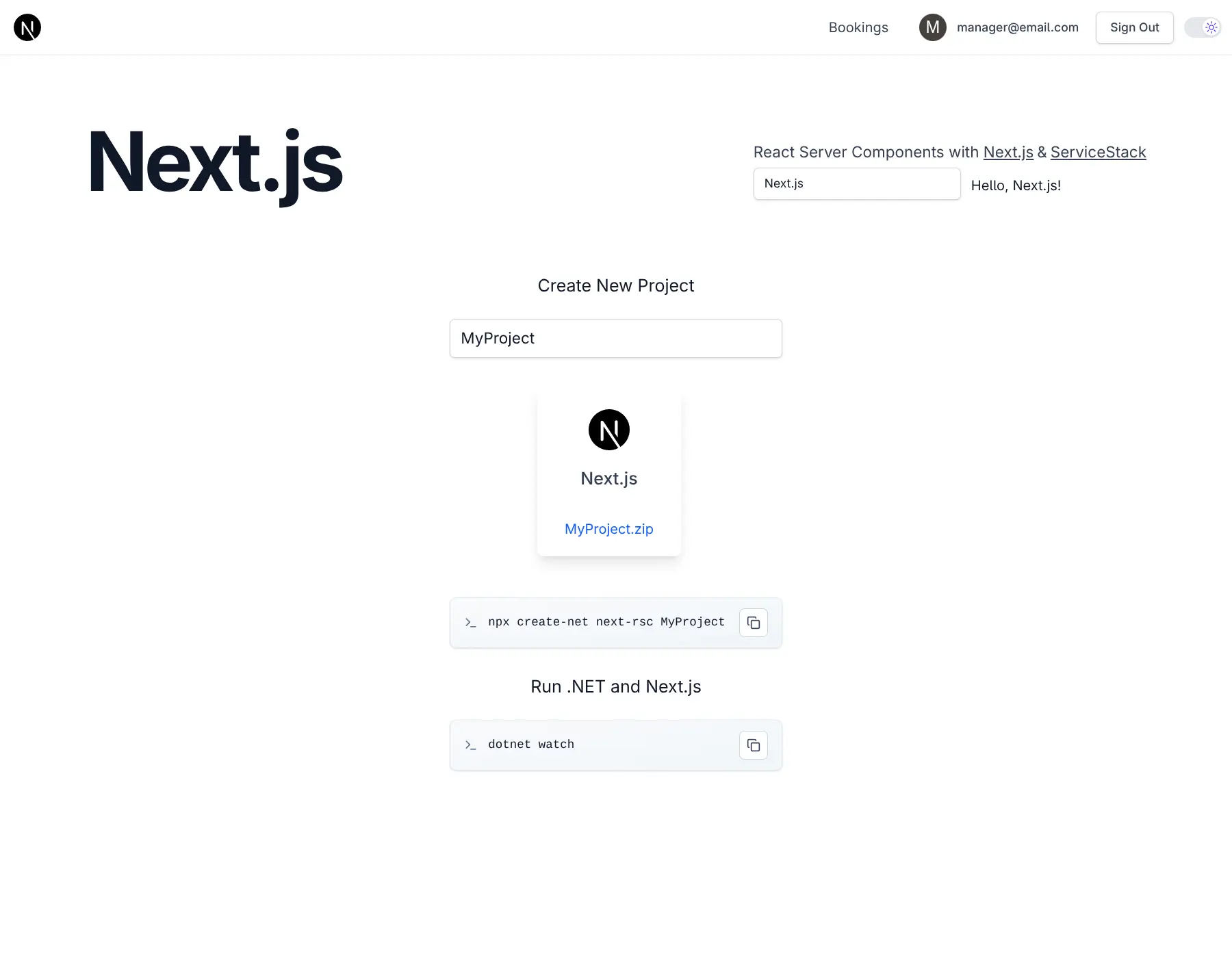
Quick Start
npx create-net next-rsc MyProjectGetting Started
Run Server .NET Project (automatically starts both .NET and Next.js dev servers):
cd MyProject
dotnet watch
Architecture
Unified Proxy Architecture
This template uses a consistent architecture across all environments where the .NET application always proxies requests to a full-featured Next.js server:
Development Mode:

- ASP.NET Core proxies requests to Next.js dev server (running on port 3000)
- Hot Module Replacement (HMR) support for instant UI updates
- WebSocket proxying for Next.js HMR functionality
- Automatic startup of Next.js dev server in
dotnet watch
Production Mode:

- Full Next.js capabilities including React Server Components and dynamic rendering
- Single container deployment with coordinated process management
- Both .NET and Node servers run side-by-side in the same unified Docker container
- ASP.NET Core proxies requests to Next.js production server (running on port 3000)
- Static file responses cached in
NodeProxyin-memory managed cache for optimal performance
Core Technologies
Frontend (Next.js 16 + React 19)
- Next.js with static export capability
- Tailwind CSS 4.x - Utility-first styling with PostCSS
- TypeScript - Type-safe development
- Vitest - Modern testing framework
- ServiceStack React Components - Pre-built UI components
.NET Frontend (Integrated + Optional)
- Razor Pages - For Identity Auth UI (
/Identityroutes)
Backend (.NET 10.0)
- ServiceStack 10.x - High-performance web services framework
- ASP.NET Core Identity Auth - Complete authentication & authorization system
- Entity Framework Core - For Identity Auth data management
- OrmLite - ServiceStack's fast, lightweight Typed ORM
- SQLite - Default database (easily upgradable to PostgreSQL/SQL Server/MySQL)
Major Features
1. Authentication & Authorization
- ASP.NET Core Identity integration with role-based access control
- Custom user sessions with additional claims
- Admin users feature for user management at
/admin-ui/users - Email confirmation workflow (configurable SMTP)
- Razor Pages for Identity UI (
/Identityroutes) - Credentials-based authentication
2. AutoQuery CRUD
- Declarative API development with minimal code
- Complete Auth-protected CRUD operations (see Bookings example at
/bookings-auto) - Automatic audit trails (created/modified/deleted tracking)
- Built-in validation and authorization
- Type-safe TypeScript DTOs auto-generated from C# models
3. Background Jobs
BackgroundsJobFeaturefor async task processing- Command pattern for job execution
- Email sending via background jobs
- Recurring job scheduling support
- Upgradable to
DatabaseJobsFeaturefor enterprise RDBMS
4. Developer Experience
- Admin UI at
/admin-uifor App management - Health checks at
/upendpoint - Modular startup configuration pattern
- Code-first migrations with OrmLite
- Docker support with container publishing
- Kamal deployment configuration included
5. Production Features
- Static asset caching with intelligent cache invalidation
- Clean URLs without
.htmlextensions - HTTPS redirection and HSTS
- Data protection with persistent keys
- Health monitoring
- Database developer page for EF Core errors
Project Structure
MyApp/                       # Main ASP.NET Core host
├── Configure.*.cs           # Modular startup configuration
├── Program.cs               # Application entry point
└── wwwroot/                 # Static files (production)

MyApp.Client/                # Next.js frontend application
├── app/                     # Next.js App Router pages
├── components/              # React components
├── lib/                     # Utilities and helpers
├── public/                  # Static assets
└── dist/                    # Build output (production)

MyApp.ServiceInterface/      # Service implementations
├── MyServices.cs            # Example services
└── Data/                    # EF Core DbContext

MyApp.ServiceModel/          # DTOs and service contracts
├── Bookings.cs              # AutoQuery CRUD example
└── Hello.cs                 # Example service contract

MyApp.Tests/                 # Integration and unit tests

config/                      # Deployment configuration
└── deploy.yml               # Kamal deployment settings

.github/                     # GitHub Actions workflows
└── workflows/
    ├── build.yml            # CI build and test
    ├── build-container.yml  # Container image build
    └── release.yml          # Production deployment with Kamal
Development Workflow
For detailed information on the development workflow, including starting development servers, generating TypeScript DTOs, database migrations, and testing, see:
Development Workflow Documentation
Configuration
For detailed configuration information, including app settings, SMTP email setup, and upgrading to enterprise databases (PostgreSQL/SQL Server/MySQL), see:
Deployment
For deployment instructions, including Docker + Kamal setup and GitHub Actions configuration, see:
Ideal Use Cases
- SaaS applications requiring authentication
- Admin dashboards with CRUD operations
- Content-driven sites with dynamic APIs
- Applications needing background job processing
- Projects requiring both SSG benefits and API capabilities
- Teams wanting type-safety across full stack