Architecture
Next SaaS is a single-runtime SaaS application. ASP.NET Core and ServiceStack own authentication, APIs, persistence, billing projection, background work, and production hosting. Next.js supplies an exported React client rather than a second production server.
Runtime shape
Browser or API client
        │
        ▼
ASP.NET Core + ServiceStack
  ├── ASP.NET Core Identity sessions
  ├── organization-scoped API keys
  ├── typed APIs and authorization policy
  ├── plans, entitlements, quotas, and usage
  ├── local Stripe subscription projection
  ├── Background Jobs and operational queues
  └── static Next.js files in production
        │
        ├── RDBMS
        ├── file/object storage
        ├── Stripe
        └── SMTP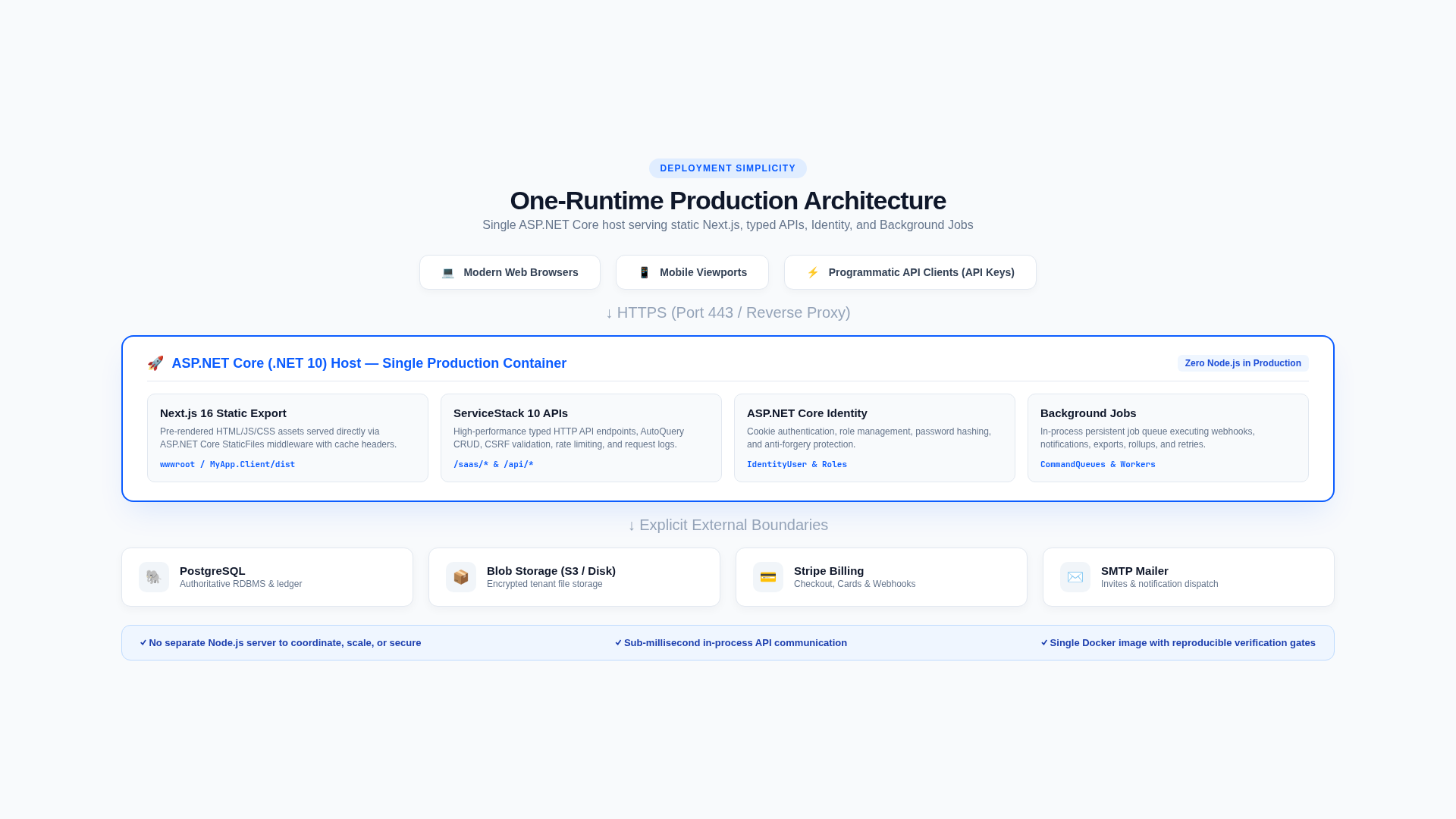
In Development, ASP.NET Core starts and proxies the Next.js development server for HMR. In Production, next build creates static files that are copied into wwwroot. Identity cookies and APIs therefore retain one public origin in both environments.
Request path
A normal customer request passes through these boundaries:
- ASP.NET Core Identity or a ServiceStack API key authenticates the caller.
IWorkspaceContextResolverreloads active membership and establishes the organization.IEntitlementResolverdecides whether the effective plan permits the feature.ISaasManagerevaluates local subscription access and quota state.- The service reads or changes only records belonging to the verified organization.
- The service appends a registered, redacted audit event where appropriate.
- Retryable, slow, or destructive work is persisted through ServiceStack Background Jobs.
The browser may select a resource or organization, but its identifier is never proof of access.
Sources of truth
| Source | Owns |
|---|---|
| Stripe | Payment methods, charges, tax, invoices, discounts, and the remote subscription |
| RDBMS | Organizations, membership, plan versions, local subscription projection, entitlements, usage, product records, audit, and lifecycle state |
| JSON configuration | Deployment-wide product identity, supported feature/meter registry, storage limits, notification switches, retention defaults, and safety policy |
| Secret store | Database, Stripe, SMTP, and deployment credentials |
| File store | Opaque customer file and export objects; the RDBMS retains metadata and authorization state |
Stripe is not queried on an authorization or quota hot path. Signed webhooks and explicit reconciliation update the local BillingSubscription, which is used to determine access.
Project boundaries
| Project | Purpose |
|---|---|
MyApp.ServiceModel | Authoritative domain records and ServiceStack request/response contracts |
MyApp.ServiceInterface | Services, policy, provider abstractions, telemetry, and job commands |
MyApp | Host composition, Identity, plugins, migrations, configuration, health, and static assets |
MyApp.Client | Static Next.js application and generated TypeScript client |
 |
| MyApp.Tests | Unit, architecture, security, isolation, migration, and optional integration tests |
Dependencies point inward through contracts and interfaces. Product services should not acquire frontend dependencies or directly embed provider-specific policy.
Important extension interfaces
IWorkspaceContextResolver— resolves verified organization membership.IEntitlementResolver— computes effective feature access.ISaasManager— manages plans, access modes, usage, quotas, reservations, and organizations.IFileStore— streams opaque file objects independent of a storage vendor.INotificationManager— creates deduplicated notification intents.IStripeBillingGateway— isolates Stripe catalog, checkout, and reconciliation behavior.
Replace implementations during host composition instead of coupling feature services to a provider SDK. For example, an S3-backed IFileStore should preserve the same opaque keys, streaming, checksum, bounded-write, and idempotent-delete guarantees as LocalFileStore.
Persistence model
The application uses EF Core for ASP.NET Core Identity and OrmLite for SaaS records. Both point to the same configured database. SQLite supports local development and deterministic verification; PostgreSQL is the default production policy.
Every OrmLite table is classified in features.json:
- global — shared plan catalog definitions;
- tenant-owned — data constrained to one organization;
- platform-operational — inboxes, deliveries, logs, snapshots, and run history.
An architecture test rejects unclassified tables. This makes ownership explicit to both maintainers and coding agents.
API and generated-code boundary
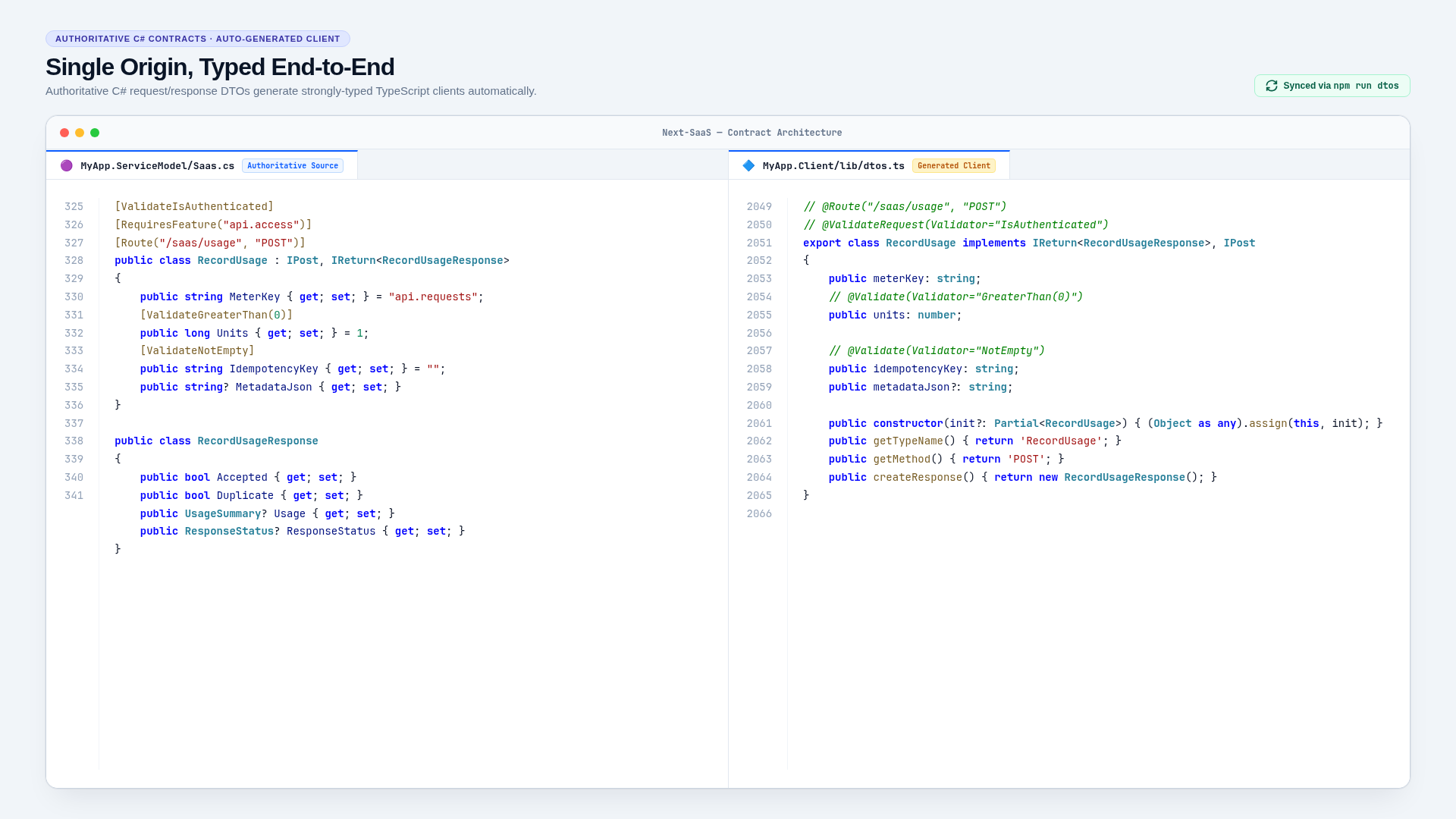
C# DTOs in MyApp.ServiceModel are authoritative. ServiceStack generates MyApp.Client/lib/dtos.ts, which the React client calls through a shared JsonServiceClient.
C# request/response DTO
        ↓
Service implementation
        ↓
ServiceStack metadata/OpenAPI
        ↓
generated TypeScript DTO
        ↓
React page or component
Regenerate after a contract change; never maintain parallel handwritten browser types.
Asynchronous boundary
HTTP requests perform bounded work. Operations requiring durable retries or delayed execution persist their intent first and enqueue a command. Workers reload current database state rather than trusting serialized customer objects.
Examples include webhook processing, file deletion, export creation, notification delivery, subscription reconciliation, retention, rollups, and delayed organization deletion.
Failure model
- External deliveries use stable idempotency or deduplication identifiers.
- Queue state and last errors remain inspectable to authorized operators.
- Destructive workflows are staged, audited, and safely replayable.
- Quota reservations prevent fallible work from oversubscribing capacity.
- Customer-visible errors include an
X-Request-Idcorrelated with structured logs. - Production startup is fail-closed when required infrastructure is missing.
Architectural invariants
- Authentication is not tenant authorization.
- Organization context is resolved server-side for every customer operation.
- Published plan versions are immutable contracts.
- Customer exceptions are explicit, time-bound where appropriate, and audited.
- Stripe owns money; local state owns request-time access.
- Subscription state never triggers customer-data deletion.
- Usage and jobs are idempotent.
- Sensitive values are redacted before audit persistence.
- Dynamic application behavior is exposed through typed APIs, not a production Next.js server.
Related concepts
Verify and ship
The final onboarding step turns a working development change into a deployment that fails early when required infrastructure or secrets are missing.
Organizations and tenancy
The UI calls a customer boundary an Organization. Internal DTOs and database records use the conventional Workspace name. They describe the same tenant boundary.