Organizations and tenancy
The UI calls a customer boundary an Organization. Internal DTOs and database records use the conventional Workspace name. They describe the same tenant boundary.
Organization context
IWorkspaceContextResolver is the mandatory boundary for tenant-facing services. It starts with an authenticated identity, reloads active membership, and returns the verified Workspace, WorkspaceMember, user ID, and effective role.
A client-provided organization or resource ID only identifies what the caller wants. Authorization comes from persisted membership and an organization-scoped query.
var context = workspaceContexts.Resolve(Db, await GetSessionAsync(), Request);Product services should pass this resolved context into entitlement, access, quota, storage, and audit operations rather than reconstructing it.
Active organization selection
One identity can belong to multiple organizations. UserWorkspacePreference stores the identity’s current selection.
GetMyWorkspacesreturns verified active memberships only.SwitchWorkspacerejects an organization outside that set.- The application shell reloads organization state after an explicit switch.
- API keys do not follow the browser’s active preference; each key is permanently bound to its organization.
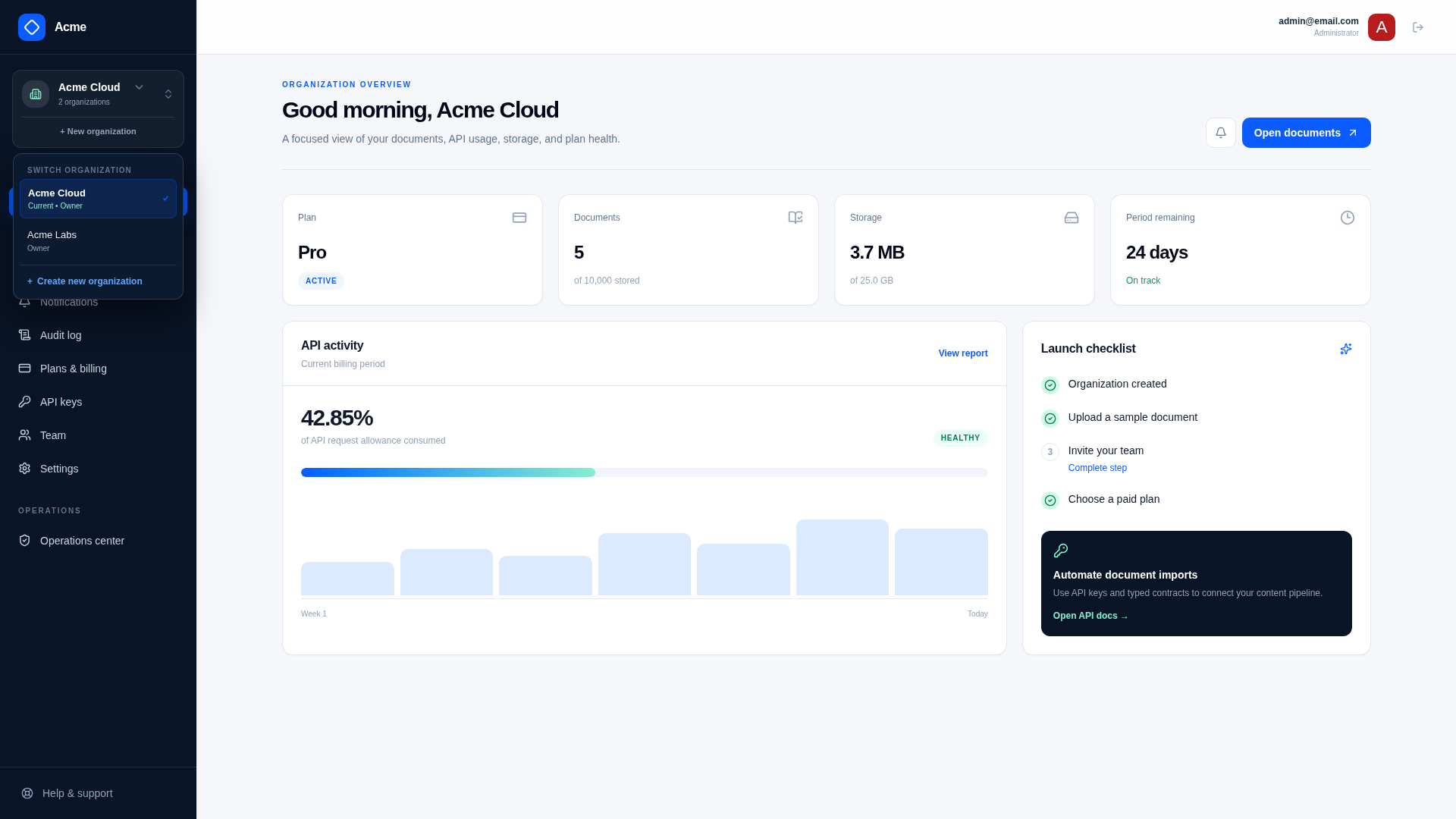
If the preference is missing or invalid, the resolver selects an active membership using deterministic fallback rules and persists the selection.
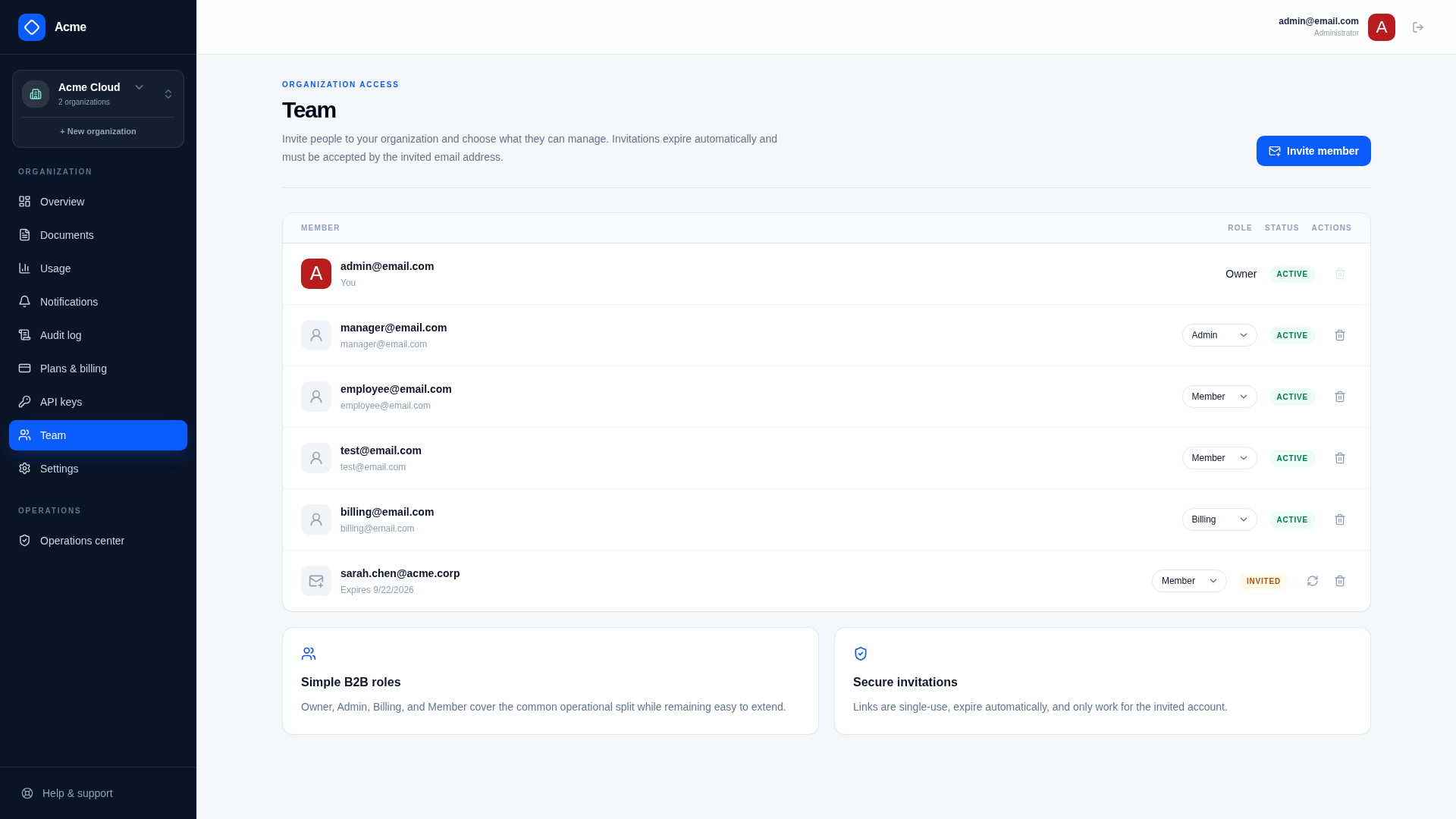
Customer roles
| Role | Typical permissions |
|---|---|
| Owner | All organization administration, ownership transfer, and destructive lifecycle actions |
| Admin | Members, settings, exports, and normal organization administration |
| Billing | Billing and subscription management without general administration |
| Member | Entitled product capabilities |
The Owner role has invariants that ordinary role editing cannot bypass:
- an organization must retain an Owner;
- an Owner transfers ownership through the explicit workflow;
- a sole Owner cannot leave;
- only the Owner can schedule or cancel organization deletion.
Role checks are centralized in WorkspaceAuthorization. UI visibility reflects permission but does not replace server checks.
Platform roles are separate
Platform operators are not organization members by implication:
| Platform role | Scope |
|---|---|
| Admin | Catalog, platform policy, customer operations, platform audit, and support approval |
| BillingAdmin | Billing-safe customer lookup, reconciliation, and Stripe retries |
| Support | Redacted customer diagnostics during an approved, started, expiring session |
A Support role alone grants no customer access. SupportAccessGrant must match the exact operator and organization and must be active, started, unexpired, and not revoked or ended.
Invitations
Invitations are persisted as pending WorkspaceMember records with:
- normalized invited email;
- random token represented by a one-way hash;
- explicit role;
- expiry and send/revoke dates.
Acceptance requires an authenticated Identity email matching the invitation. Expired, revoked, already active, or mismatched invitations are rejected. A pending invitation may also be promoted on a subsequent authenticated SaaS request after its email is verified.
Tenant-owned queries
Every tenant record lookup must include the verified organization:
var file = Db.Single<StoredFile>(x =>
    x.Id == request.Id &&
    x.WorkspaceId == context.Workspace.Id);
Avoid loading by primary key and checking later, particularly before returning data or acting on an object-store key. Apply the boundary in reads, updates, deletes, downloads, analytics, exports, caches, and job commands.
API keys
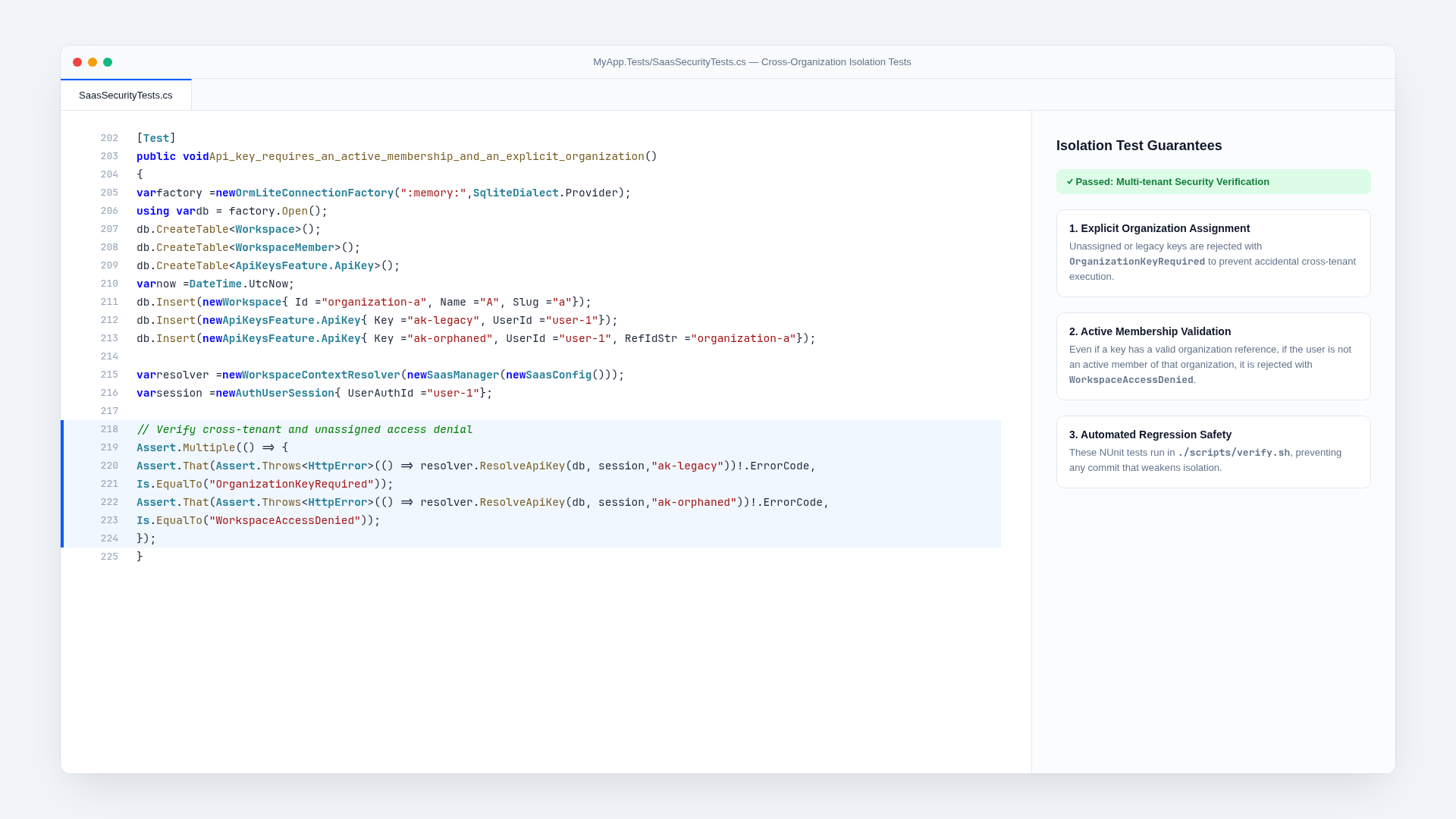
ServiceStack API keys are bound using RefIdStr = WorkspaceId. Resolution requires:
- an active, non-revoked key;
- an explicit organization binding;
- an active membership for the key’s user in that organization;
- applicable feature and rate-limit policy.
Changing the user’s browser-selected organization does not change the API key. Raw keys are shown only once; later lists expose a safe visible fingerprint.
Files and exports
Object keys contain opaque IDs rather than customer filenames:
workspaces/{workspace-id}/files/{opaque-id}
workspaces/{workspace-id}/exports/{lifecycle-request-id}.zip
Original names remain metadata. Authorization loads the exact organization-owned row before opening or deleting its object. Export construction queries each included table by WorkspaceId and writes to an organization-specific object key.
Background jobs
Job messages carry stable resource identifiers, not trusted serialized customer state. A worker reloads the row, its current organization, status, policy, and relevant provider state before acting.
This matters when access, a legal hold, deletion status, or membership changes while work is queued.
Adding tenant-owned data
When adding a table:
- Add a required, indexed
WorkspaceIdunless the ownership is indirect and rigorously enforced. - Classify the table as
tenantOwnedinfeatures.json. - Scope every service query and mutation to the resolved organization.
- Include it deliberately in export, retention, and deletion policy.
- Avoid customer-provided object-store paths and cache keys.
- Add cross-organization read, update, delete, download, and job tests.
- Decide what platform Support, BillingAdmin, and Admin roles may see, including redaction.
Common mistakes
- Treating an authenticated user ID as authorization for all of that user’s organizations.
- Accepting
WorkspaceIdfrom the body without reloading membership. - Looking up a resource by ID alone.
- Reusing browser active-organization state for API keys.
- Giving platform Support permanent or implicit customer access.
- Omitting new customer data from export and deletion workflows.
Related concepts
Architecture
Next SaaS is a single-runtime SaaS application. ASP.NET Core and ServiceStack own authentication, APIs, persistence, billing projection, background work, and production hosting. Next.js supplies an exported React client rather than a second production server.
Plans and entitlements
Plans describe commercial packages. Entitlements answer whether an organization may use a capability. Published plan versions make those answers stable for existing subscriptions while the catalog evolves.