API keys
API keys provide organization-bound programmatic access without exposing the full ServiceStack scope editor in the customer UI.
Customer workflow
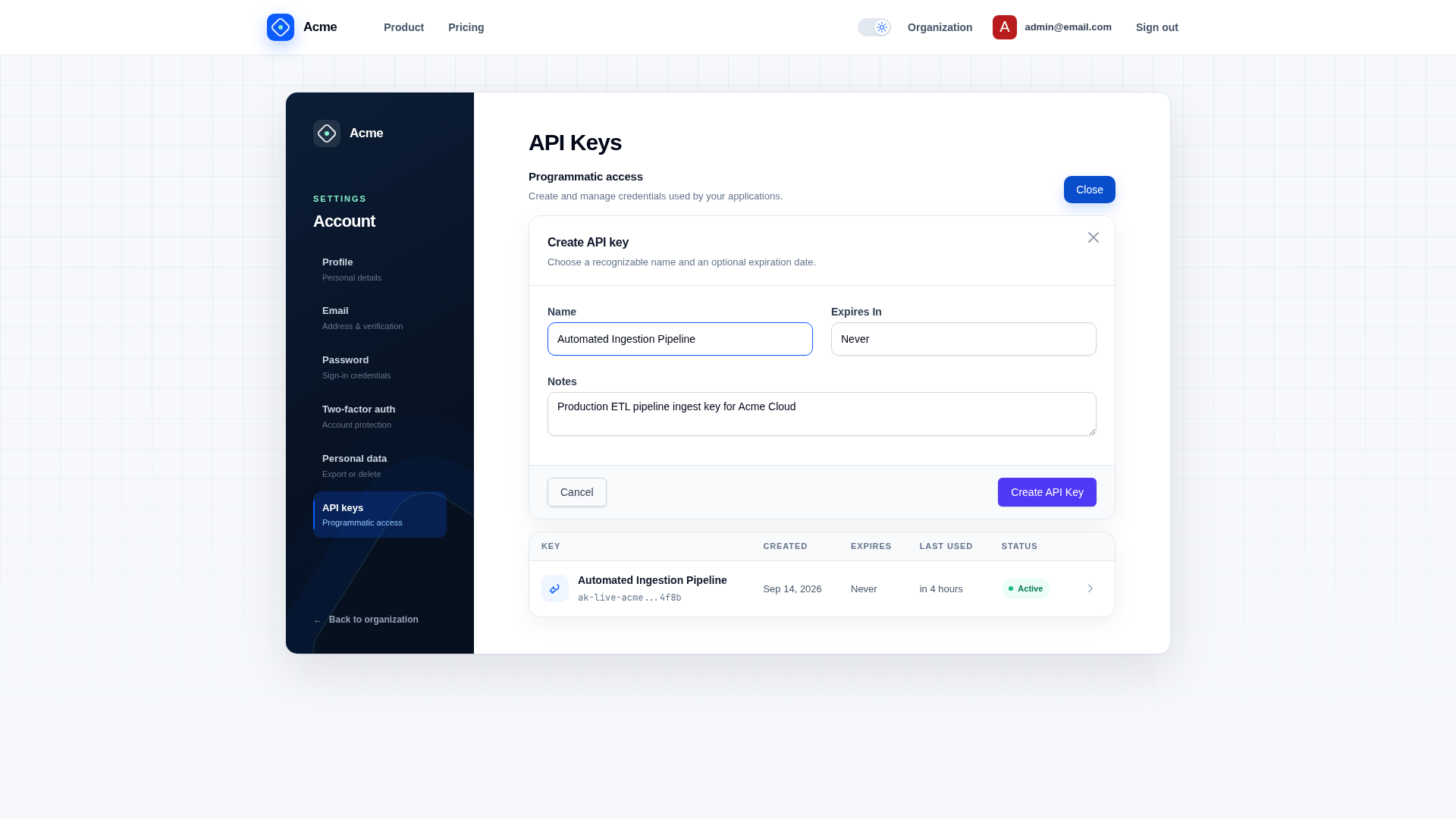
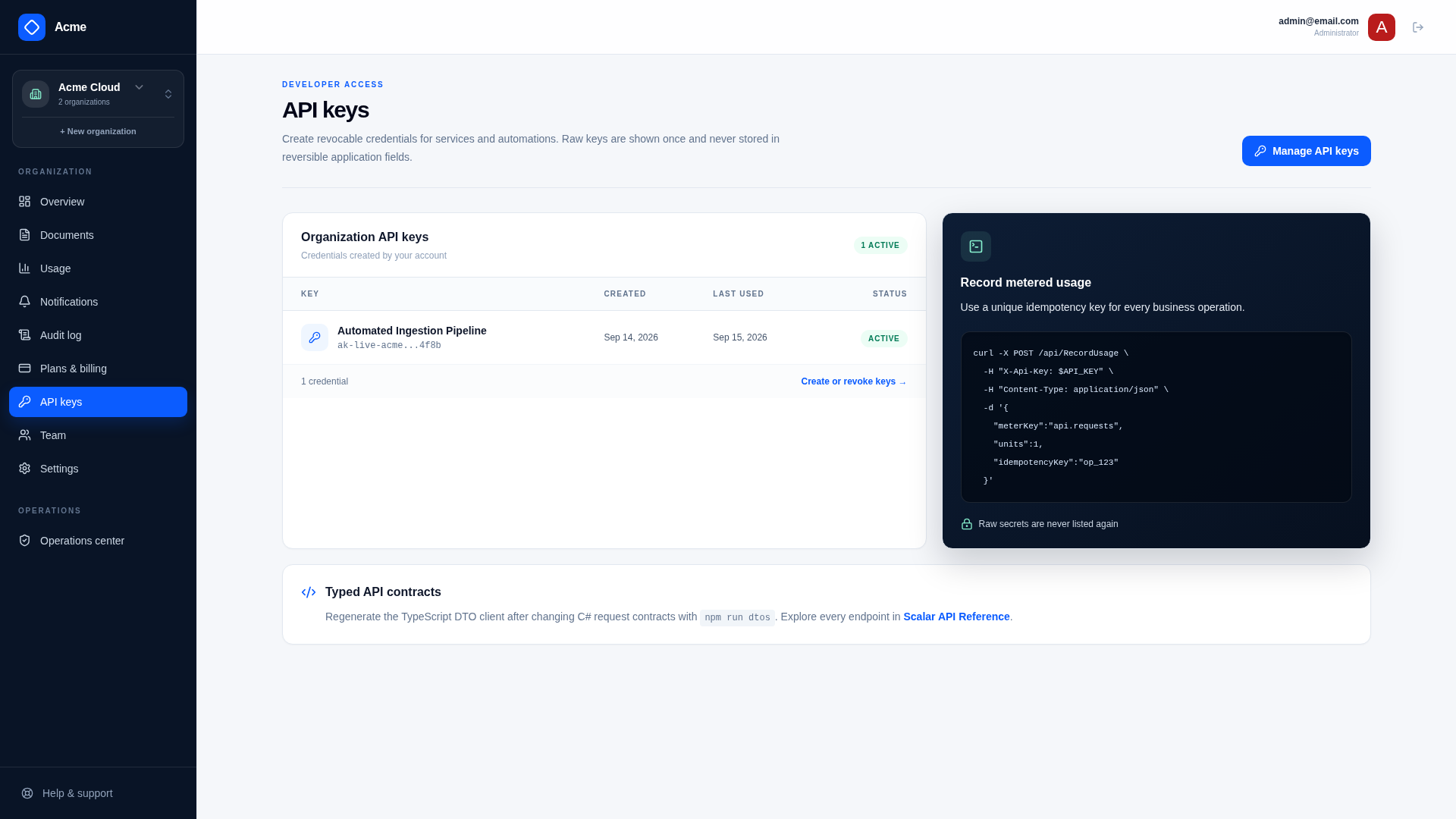
An authenticated member selects an organization, opens Settings → API keys, and creates a named credential. The raw key is displayed once. Later views show only its fingerprint and metadata, so a lost key must be replaced rather than recovered.
The management page intentionally asks only for a name and optional expiry. The server assigns the template's standard scopes: usage:read, usage:write, and workspace:read.
ServiceStack integration
Configure.ApiKeys.cs registers ApiKeysFeature and applies SaaS-specific request and response filters around ServiceStack's API-key DTOs.
The filters:
- bind a new key to the active organization through
RefIdStr; - require the
api.accessentitlement; - filter lists to the active organization;
- prevent moving a key between organizations;
- require an interactive session to create, update, or delete credentials;
- prevent an API key from managing other keys;
- record create, update, and delete audit events.
Use the generated ServiceStack DTOs for the exact API-key routes and payloads. The account UI lives in MyApp/Areas/Identity/Pages/Account/Manage/ApiKeys.cshtml.
Authentication and isolation
Send a credential using the ServiceStack bearer or API-key authentication supported by ApiKeysFeature. The organization is resolved from the stored key, not from the browser's active selection or a caller-supplied organization ID.
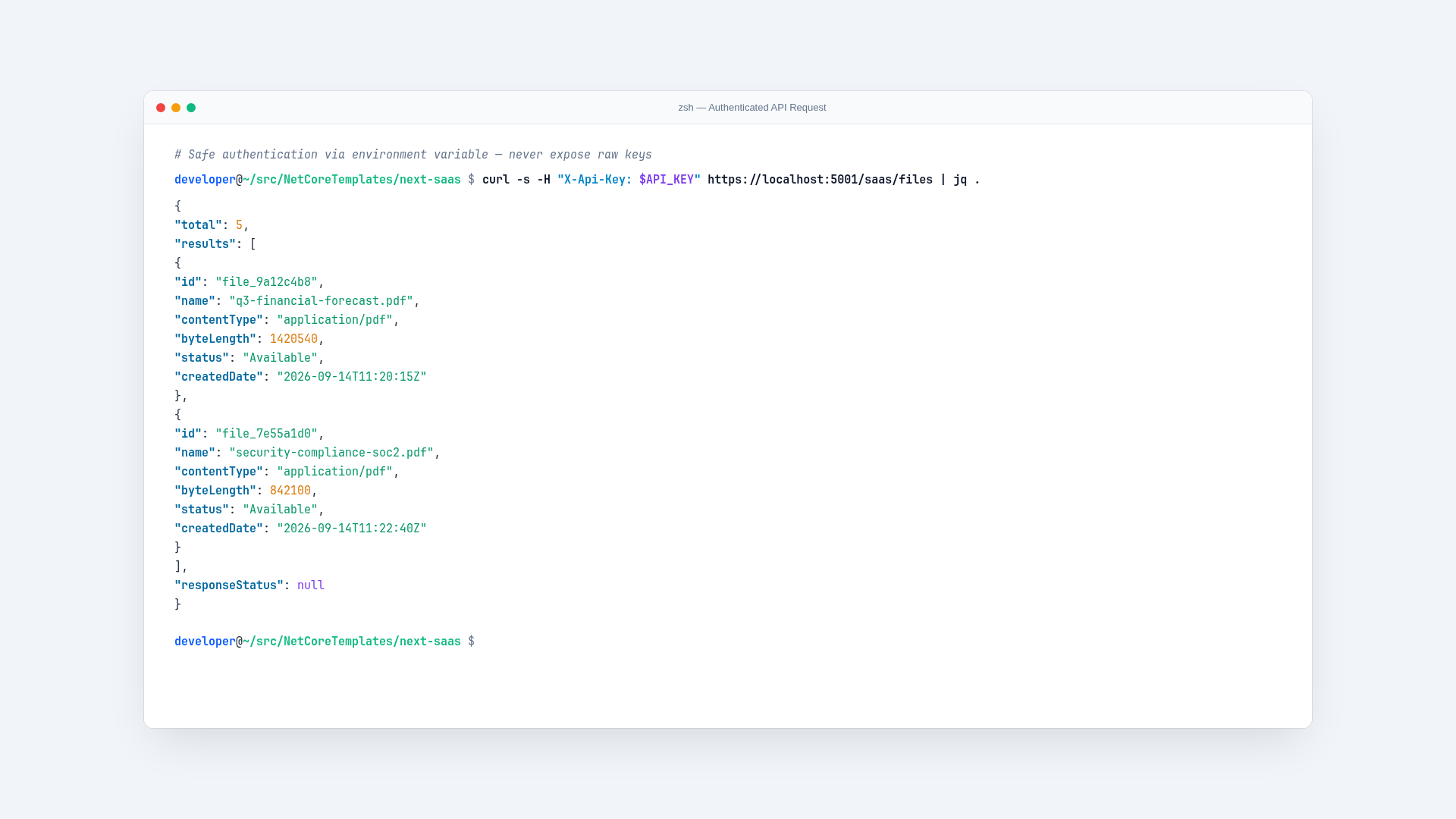
Revoked, expired, or cross-organization credentials fail before product data is returned. Credential material must never be logged or added to audit metadata.
Rate limiting
Saas.ApiKeyRequestsPerMinute sets a per-process, fixed-window limit keyed by organization and a SHA-256 hash of the credential. Rejection returns HTTP 429 and Retry-After.
The included limiter is suitable for a single application instance. Replace SaasApiRateLimiter with a shared Redis or gateway-backed implementation before horizontally scaling.
Extension points
- Change the fixed scope set in
Configure.ApiKeys.csif the product exposes different programmatic operations. - Add credential-level usage attribution by storing a non-secret key identifier on usage events.
- Add rotation overlap or IP restrictions only when customers need them; keep the default UI small.
- Preserve organization binding and interactive management rules when replacing
ApiKeysFeatureUI.
Verify
Create a key in organization A, copy it once, call an allowed API, and confirm it appears in that organization's list. Switch to organization B and confirm it is absent. Test expiry, revocation, the rate limit, missing api.access, and an API-key attempt to create another key.
Related documentation
Organizations and members
Organizations isolate customer data, subscriptions, quotas, files, API keys, settings, and lifecycle operations. One user can belong to several organizations.
File storage
The Acme sample stores ordinary files to demonstrate feature gates, document-count quotas, byte quotas, idempotency, analytics, and cleanup without imposing a document-processing domain.