File storage
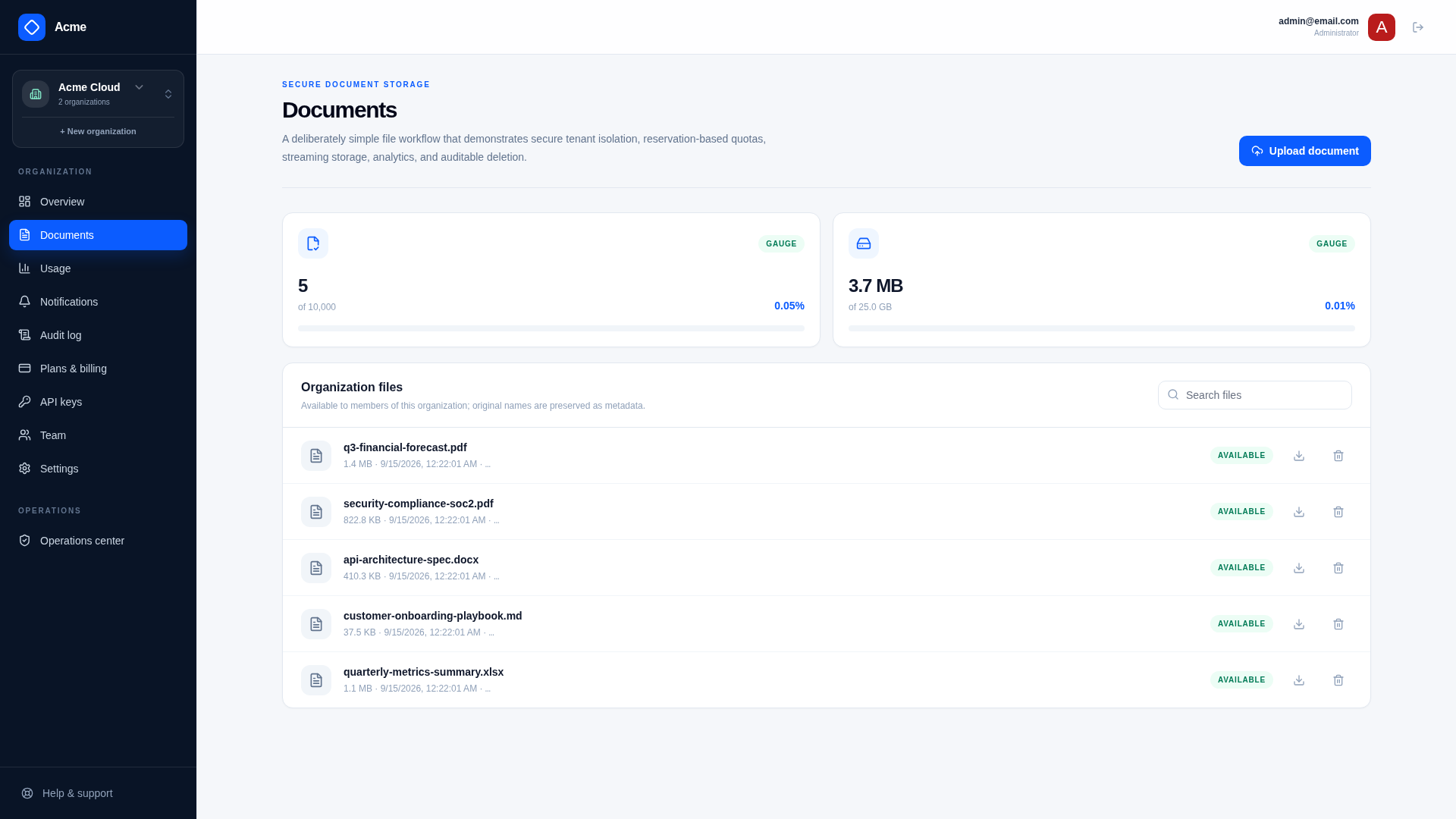
The Acme sample stores ordinary files to demonstrate feature gates, document-count quotas, byte quotas, idempotency, analytics, and cleanup without imposing a document-processing domain.
APIs
| Operation | Route |
|---|---|
| List/search | GET /saas/files |
| Upload | POST /saas/files |
| Download | GET /saas/files/{Id} |
| Delete | DELETE /saas/files/{Id} |
Upload, download, and delete require the files.basic entitlement. Every lookup is constrained to the active organization. Upload is multipart and requires an IdempotencyKey.
Storage model
StoredFile keeps tenant-safe metadata in the RDBMS. IFileStore stores bytes behind an opaque object key and exposes write, read, delete, and existence operations. LocalFileStore is the default implementation and writes beneath FileStorage.RootPath.
Do not expose physical paths to customers or use user-provided filenames as object keys. To adopt S3, Azure Blob Storage, or another provider, replace IFileStore while retaining metadata, organization isolation, and cleanup semantics.
Quota transaction
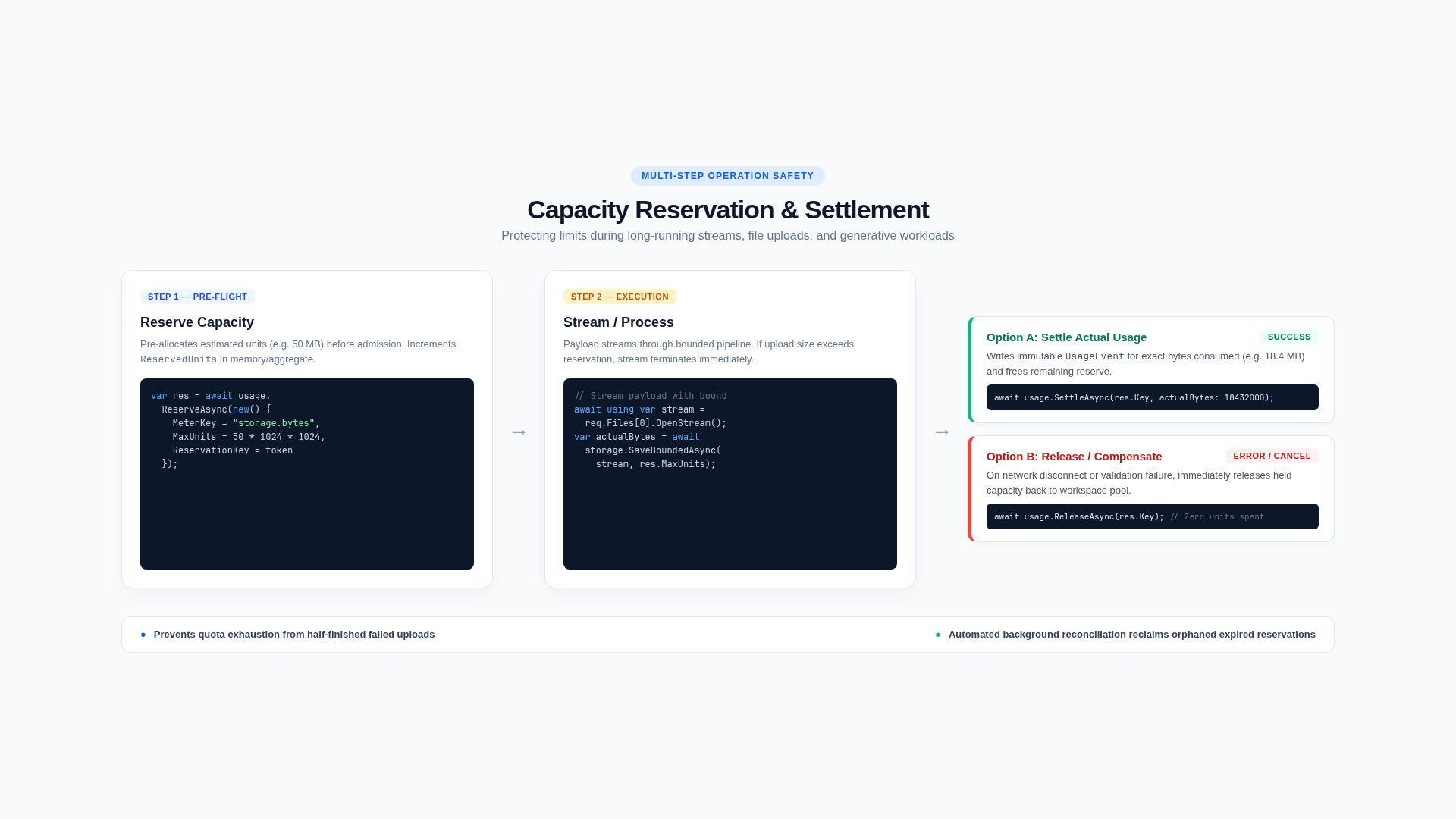
An upload follows a reserve/perform/settle pattern:
- validate membership, entitlement, extension, and configured maximum size;
- reserve one
documentsunit and the expectedstorage.bytescapacity; - stream to
IFileStore, enforcing the byte maximum and calculating SHA-256; - settle the reservations to actual usage and commit metadata;
- compensate reservations and remove partial bytes if any step fails.
Delete makes the file unavailable and queues physical cleanup. This keeps the customer request fast and makes retries safe.
Configuration
{
  "FileStorage": {
    "RootPath": "App_Data/files",
    "MaxFileBytes": 104857600,
    "AllowedExtensions": [ ".pdf", ".txt", ".md" ]
  }
}
MaxFileBytes is a global safety limit. Plan quotas remain customer-specific commercial limits. Validate file content independently if the derived product accepts untrusted formats; an extension and browser content type are not security boundaries.
Extension points
- Replace
IFileStorewith cloud object storage and use short-lived signed downloads where appropriate. - Add malware scanning as a background transition before marking a file available.
- Add domain metadata in separate tenant-bound tables rather than overloading
StoredFile. - Emit new meter events only through the quota manager so failure compensation remains correct.
Verify
Test allowed and blocked extensions, empty and oversized files, duplicate idempotency keys, hard quota rejection, interrupted writes, cross-tenant IDs, downloads, deletes, retry cleanup, and empty-state recreation.