Plans and entitlements
Plans describe commercial packages. Entitlements answer whether an organization may use a capability. Published plan versions make those answers stable for existing subscriptions while the catalog evolves.
Model
SaasPlan
  └── SaasPlanVersion
        ├── SaasPlanPrice
        ├── SaasPlanFeature
        └── SaasPlanQuota

BillingSubscription ──pins──> SaasPlanVersion
CustomerEntitlementOverride ──overrides──> feature or meter key
SaasPlan is the durable product identity and public code. A version is an immutable commercial contract after publication. Prices, features, quotas, and trial days belong to that version.
Plan lifecycle
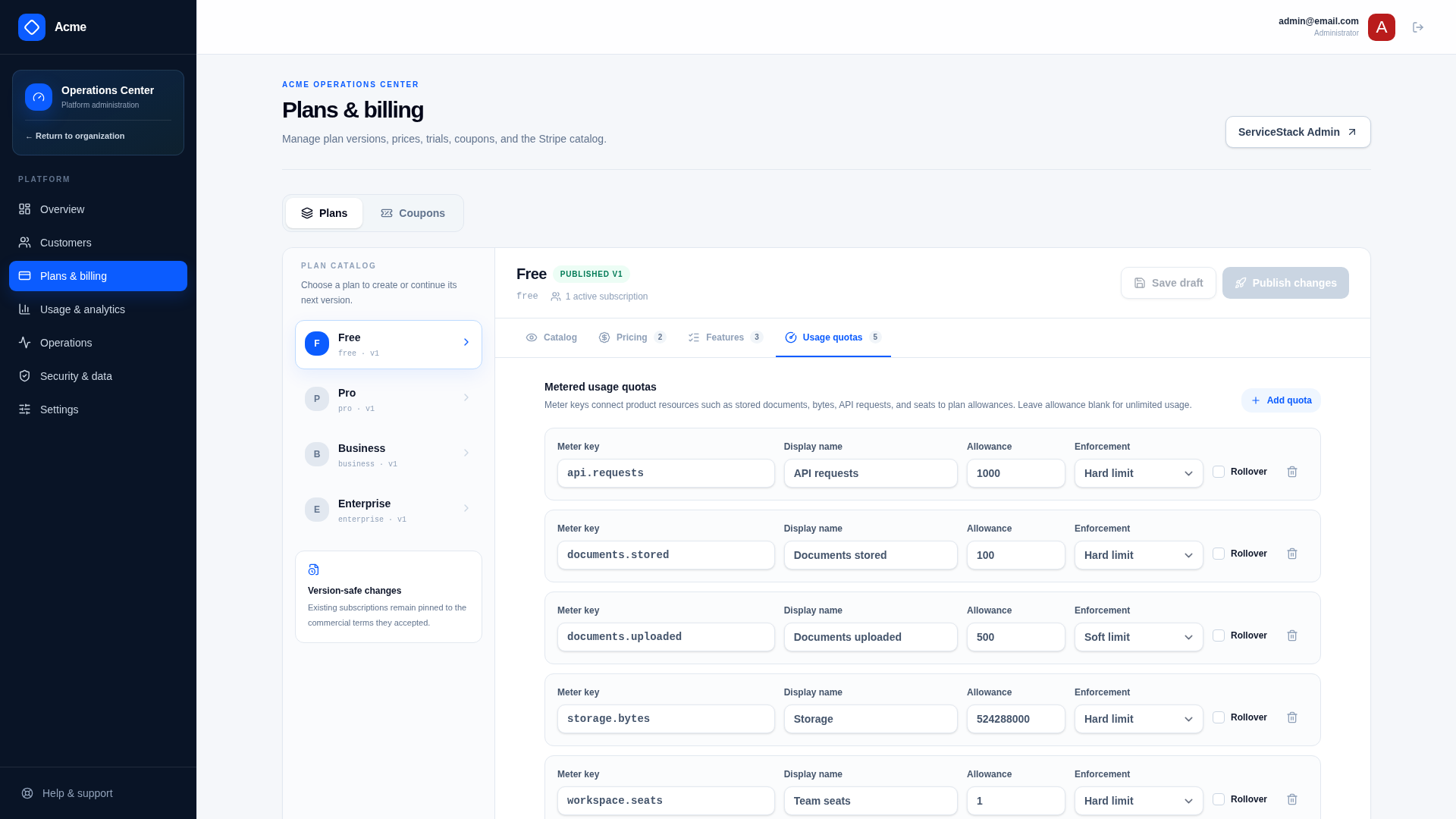
The admin workflow is draft then publish:
- An Admin edits a draft version.
- Stripe Products and Prices can be provisioned for missing draft mappings.
- Validation rejects unknown feature/meter keys and invalid price or trial values.
- Publishing retires the previous published version and makes the draft available to new selections.
- Existing
BillingSubscriptionrows remain pinned to their prior version.
Changing the public name on SaasPlan or editing a draft must not silently rewrite an existing customer’s allowances or price contract.
Feature registry
Feature keys are defined under Saas.Features in JSON. A definition supplies display metadata and a global fallback:
{
  "Key": "analytics.advanced",
  "DisplayName": "Advanced analytics",
  "Description": "View usage breakdowns and projections.",
  "Category": "Analytics",
  "DefaultEnabled": false
}
Plan administration may grant only registered keys. This prevents a typo from becoming a silent, permanently stored contract.
Use domain-stable names such as reports.export or api.access. Do not use Stripe Product/Price IDs or UI labels as feature keys.
Resolution precedence
For a feature, IEntitlementResolver applies:
- an active customer override;
- the subscription’s pinned plan version, or the published Free version during
FreeFallback; - the configured global fallback.
An override is active when its optional start has arrived and its optional expiry has not. Expired overrides are ignored without requiring destructive cleanup.
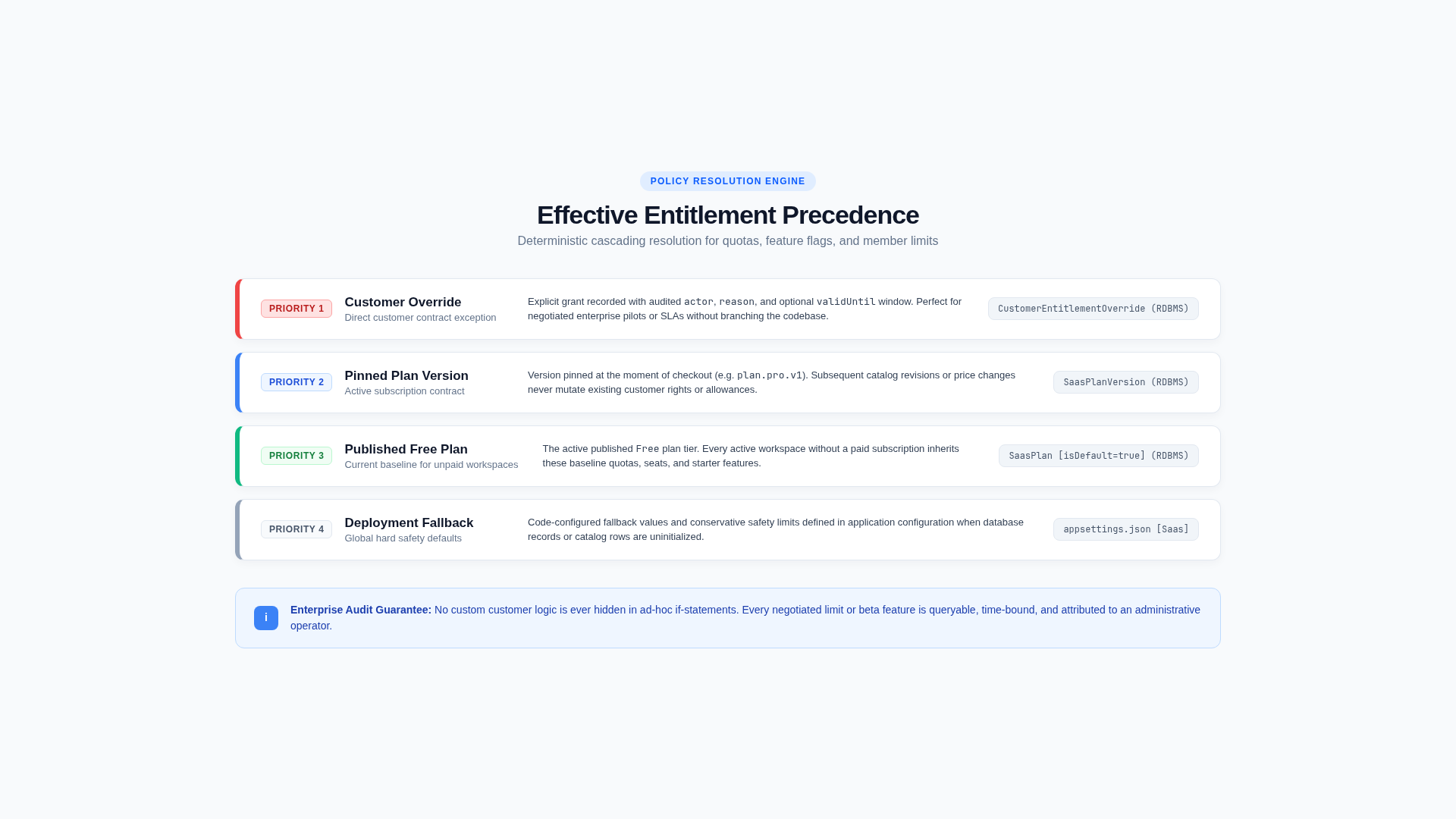
GetEffectiveEntitlements returns each effective value, source, and expiry. The dashboard includes the same information for explanatory UI.
Server and client enforcement
Use [RequiresFeature("feature.key")] on the ServiceStack request DTO for normal feature enforcement. The global request filter resolves the current organization, subscription, and effective entitlement.
[ValidateIsAuthenticated]
[RequiresFeature("reports.export")]
[Route("/reports/export", "POST")]
public class ExportReport : IPost, IReturn<ExportReportResponse> { }
React may use FeatureGate or dashboard entitlement state to hide controls and explain upgrades. The API remains authoritative because clients can be modified or bypassed.
Quotas are related but distinct
A feature answers yes/no. A plan quota answers how much. A feature may be enabled without a quota, and a quota may vary by plan or customer contract.
Customer overrides reuse CustomerEntitlementOverride:
Enabledoverrides a feature;QuotaUnitsoverrides a meter allowance;ValidFromandValidUntilbound its applicability;Reasonand audit metadata explain why it exists.
Avoid encoding quotas inside feature keys such as reports.100. Keep capability and allowance independently queryable.
Free fallback and access modes
BillingSubscription.AccessMode controls broad workspace access. When global past-due policy chooses FreeFallback, feature and quota resolution uses the published Free plan while retaining the customer’s pinned paid version.
Other modes may permit full, grace, read-only, or suspended behavior. Access-mode evaluation happens before product writes. A subscription transition does not delete product data or alter plan history.
Initial plans versus runtime plans
MyApp/plans.json seeds an empty database. It is ideal for template customization and deterministic tests. After deployment, plan state is owned by the RDBMS and managed from the Plans tab at /admin/plans.
Changing plans.json does not update a populated database. Use a plan draft/publish workflow or a deliberate migration for an existing installation.
Customer exceptions
Overrides are meant for negotiated contracts, temporary enablement, incident recovery, or controlled rollout—not as a replacement for coherent plans.
Every override should:
- use a registered key;
- record a business reason and actor;
- have an expiry when the exception is temporary;
- appear in Customer 360 diagnostics;
- produce an audit event on creation and removal.
Adding a feature safely
- Define its stable key in
Saas.Features. - Add it to relevant clean-state plans and runtime drafts.
- Protect server APIs with
RequiresFeatureor explicit resolver policy. - Add explanatory UI using effective entitlement state.
- Test plan grant, fallback, override, override expiry, and denial.
- Update
features.json.
Common mistakes
- Editing a published plan version in place.
- Assuming publishing migrates existing subscriptions.
- Checking only the browser entitlement.
- Using price IDs as product capabilities.
- Creating an unregistered override key.
- Using indefinite overrides for ordinary plan design.
- Treating a payment failure as permission to delete customer data.
Related concepts
Organizations and tenancy
The UI calls a customer boundary an Organization. Internal DTOs and database records use the conventional Workspace name. They describe the same tenant boundary.
Usage and quotas
The quota system separates immutable evidence of consumption from fast, transactionally updated admission state. It enforces limits locally without relying on Stripe aggregation.