Testing
Tests should concentrate on SaaS policy boundaries: authorization, organization isolation, idempotency, quota edges, immutable contracts, external-event replay, and recovery.
Development recipes · Verify and ship
Backend tests
Run all .NET tests from the repository root:
dotnet test MyApp.slnxUse fast in-memory SQLite tests for policy and persistence behavior. Seed only the minimum organization, membership, plan version, subscription, quota, and period needed for the scenario. Assert stable HTTP error codes as well as status.
For concurrency-sensitive aggregate changes, set TEST_POSTGRES_CONNECTION to an administrative PostgreSQL connection. The integration fixture creates and drops an isolated schema and is skipped when the variable is absent.
High-value backend cases include:
- unauthenticated, wrong-role, and cross-tenant access;
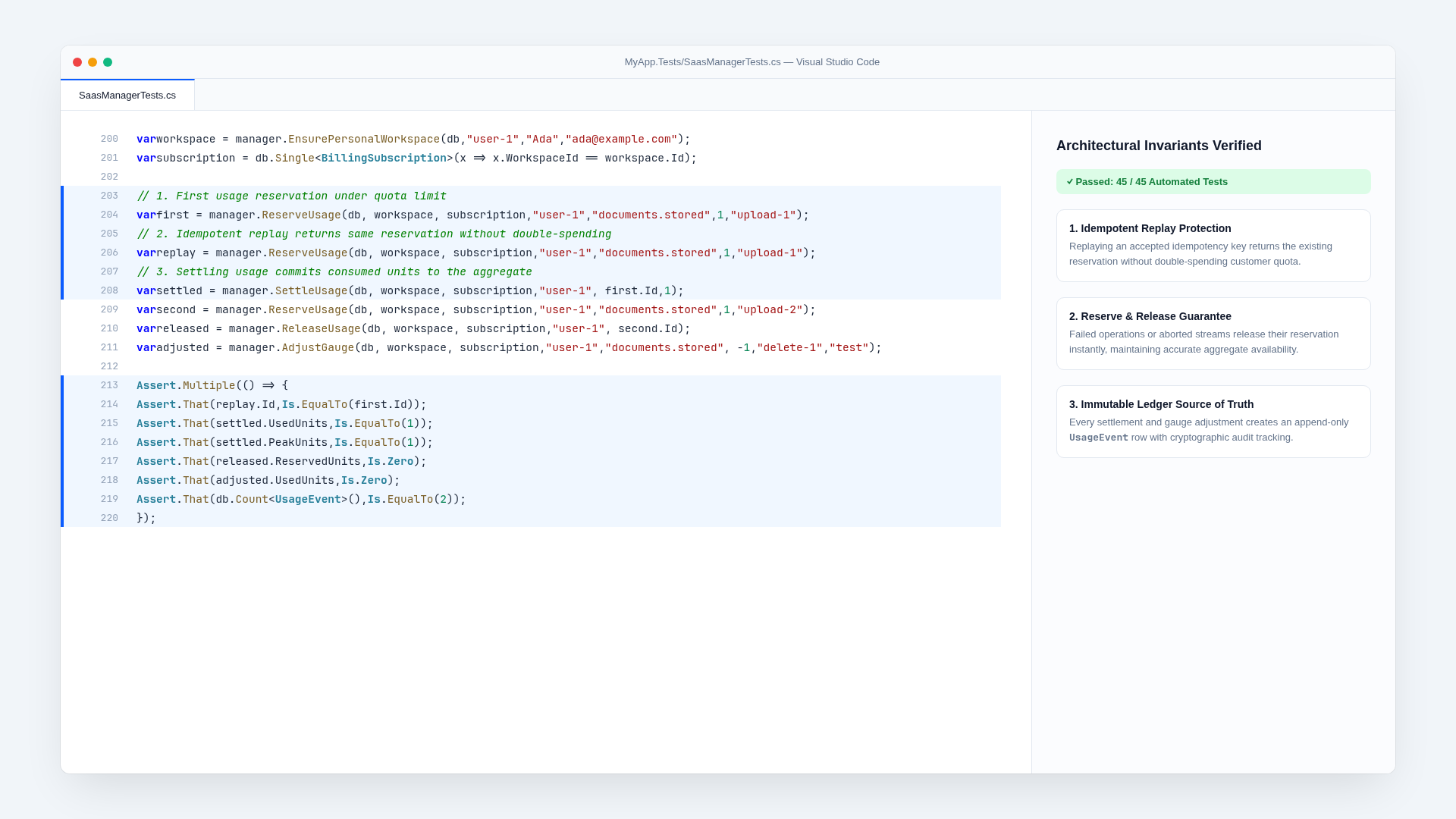
- first operation, idempotent replay, exact quota, and over-limit rejection;
- reservation settle, release, expiry, and concurrent admission;
- plan-version pinning and override precedence;
- webhook signature rejection, duplicate inbox events, and replay;
- support-access expiry/redaction and lifecycle legal hold;
- audit redaction and retention boundaries.
Tests that open their own connections set audit columns the same way as the application, through the OnOpenConnection hook registered in AssemblySetup. Use .SetUserId("user-1") to write as a user and .ForWorkspace(id) to confine a connection to an organization.
| Test class | Protects |
|---|---|
TenantIsolationTests | Every table implementing IHasWorkspaceId is confined to its organization for selects, updates, deletes, and inserts, and a connection without an organization throws |
WorkspaceAccessTests | A request has to say which organization it is for and be a member of it, and suspended, read-only, and pending-deletion organizations allow only the access they should |
WorkspaceDataTests | Deleting one organization leaves every table of another untouched, an export contains every exported table and no other organization's ID, and file keys are checked per organization |
MaintenanceJobTests | Jobs that process every organization only change the rows they should |
SaasAuditRuleTests | Audit columns are set by the connection, application values are replaced, and CreatedBy survives an update by another user |
ArchitectureGuardTests | Template-wide invariants that are easy to accidentally weaken |
ArchitectureGuardTests fails when:
- a table created by the migration is not classified, or a table classified as
tenantOwneddoes not implementIHasWorkspaceId; - a tenant-owned table has no index that starts with
WorkspaceId; - a table has audit columns without deriving from
SaasAuditBase; - a Request DTO with a
WorkspaceIddoes not implementIRequireWorkspace; - an API that API keys can call is not on the allow-list, or is not for an organization;
AcrossWorkspaces(),OpenAcrossWorkspaces(),WithoutFilters(), or raw SQL is used outside its allow-list of reviewed files;- raw SQL is not written with
Sql.Fmt(); - a connection is opened with
dbFactory.Open()instead ofOpenForWorkspace()orOpenAcrossWorkspaces().
Every test that reads source code is in this fixture. The others are checked from the compiled types.
The isolation, export, deletion, and job tests run on SQLite, and on PostgreSQL when TEST_POSTGRES_CONNECTION is set, each in a schema of its own.
What the tests do not cover
- An API whose Request DTO forgets
IRequireWorkspace. It fails on its first request, so call each new API once against a running application. - Connections opened by plugins without the request. They are not confined. See Tenant isolation.
- API-key requests end to end. Authentication happens in ASP.NET Core before a service runs, so call an API with a key against a running application.
- SQL Server and MySQL. The tests run on SQLite and PostgreSQL only.
Frontend tests
From MyApp.Client:
npm run typecheck
npm run test:run
npm run build
Vitest and Testing Library cover hooks, feature gates, and complex admin components. Prefer observable behavior over implementation details. Mock the typed client boundary and test loading, empty, error, success, mutation refresh, and entitlement states.
When testing effects, assert the request count as well as rendered output. This catches unstable dependency loops that otherwise appear as flickering pages and repeated APIs.
Full repository gate
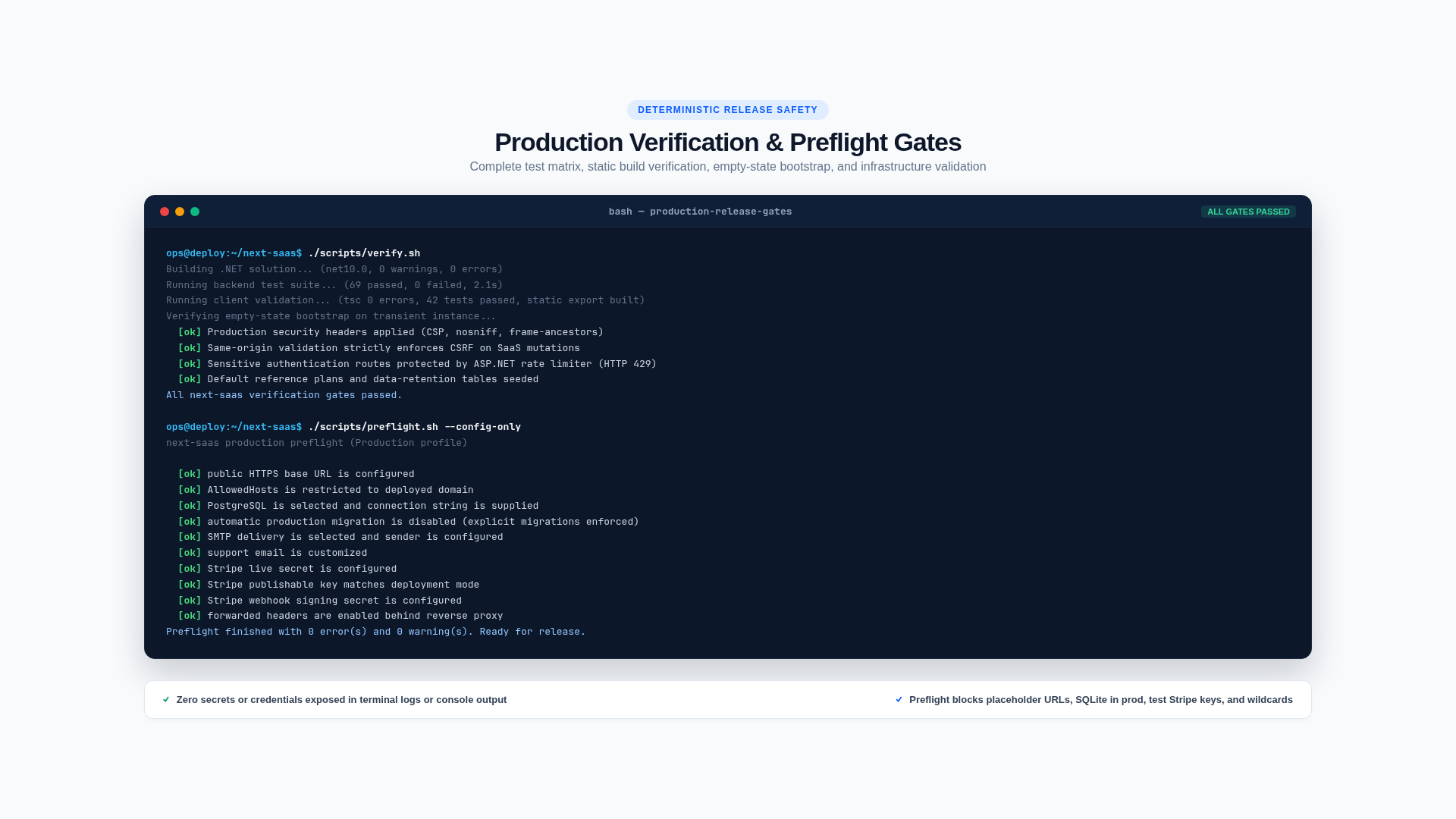
./scripts/verify.shThis builds and tests .NET, type-checks/tests/builds React, then starts production mode against a fresh temporary SQLite database and verifies empty-state bootstrap. Run it before handing off any cross-cutting change.
Test-data safety
Never point destructive/reset tests at a non-disposable database. Keep secrets out of snapshots and captured request output. Clean generated databases and local object-store files before committing.
Related documentation
Generate typed DTOs
MyApp.ServiceModel is the contract source of truth. MyApp.Client/lib/dtos.ts is generated and must never be hand-edited.
AI-assisted development
The template is organized so coding agents can follow explicit contracts, stable extension seams, small configuration files, and deterministic validation commands.